


The public knows the National Security Agency as an intelligence organization dedicated to the collection and analysis of communications intelligence. But connections found in the Majestic Document holdings, combined with previously released FOIA disclosures, allude to a deeper, more complex origin story for the agency than the official record suggests.
A Note on the Majestic Documents
The Majestic Documents have long been a subject of debate among researchers. Critics have questioned their authenticity, and that skepticism should be acknowledged. However, in recent years a growing body of corroborating evidence has lent credibility to portions of the collection. Classification markings, document formatting conventions, and administrative metadata found in the Majestic holdings have since been validated by independently released government records, documents that were still classified at the time the Majestic materials first surfaced. This pattern of after-the-fact corroboration makes a blanket dismissal of the collection increasingly difficult to justify. With that context in mind, the following analysis draws on one such document and cross-references it against verified official sources wherever possible.
Origins of the Document
Among the materials in the Majestic Documents collection, sourced from the individual known as S-2, acquired by researcher Timothy Cooper, and indexed on September 16, 1999, is a document titled “Unidentified Aircraft Sightings Over the United States”. It is dated September 30, 1947, and is described as a re-typed “best available” version that S-2 was able to obtain.
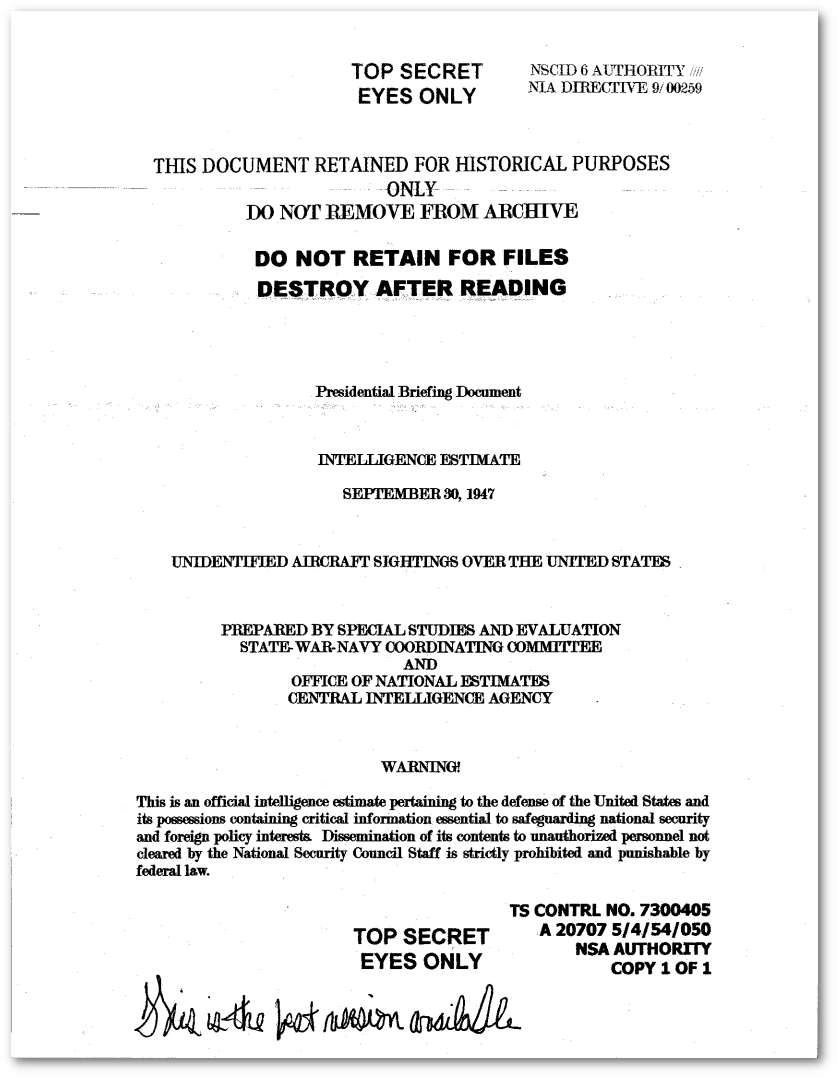
On initial glance, the document appears to be a presidential intelligence briefing assessment prepared for President Truman. It was authored by the State-War-Navy Coordinating Committee (SWNCC), in many ways the precursor to the National Security Council, which would not hold its first official meeting until weeks after this assessment was presumably delivered. In preparing the report, the SWNCC consulted with the Office of National Estimates within the Central Intelligence Agency.
The documents date can be independently corroborated. SWNCC 304/6, the Subcommittee on Special Studies and Evaluation’s foundational proposal for a national psychological warfare organization, was prepared and circulated through SWNCC channels on September 30, 1947, the same date as the Majestic document. This is official proof that the subcommittee was actively producing reports on the day the Majestic report claims to have been prepared. SWNCC 304/6 was not declassified until July 3, 2002, three years after the Majestic SSE report was indexed, making the date match another instance of after the fact corroboration.
Verification
This document can be substantially corroborated using metadata and circumstantial evidence from official sources.
The Psychological Warfare Subcommittee
The State-War-Navy Coordinating Committee Subcommittee on Special Studies and Evaluation was a real subcommittee born out of the need for an ad hoc committee to coordinate psychological warfare operations, as explained in the charter document SWNCC 304/1. This document describes an organization needed for both overt and covert psychological warfare tactics and plans "in the time of war (or in the threat of war as determined by the President)." A persistent threat from an unidentified source would appear to meet this threshold.
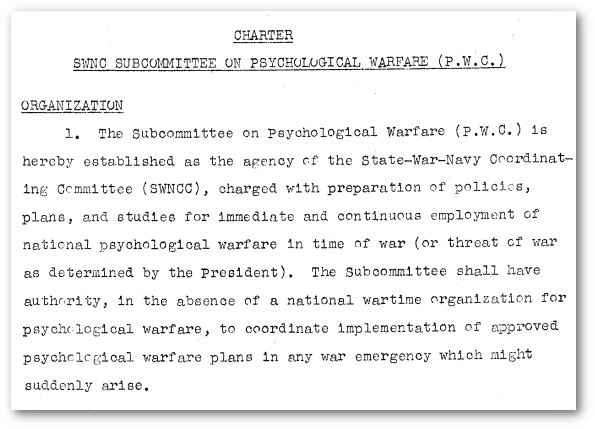
An intriguing thing to note is that the Special Studies and Evaluation (SSE) was a cover name for the Subcommittee on Psychological Warfare, formally adopted on June 5, 1947 as documented in SWNCC 304/6.
When the National Security Act of 1947 established the Air Force as a separate branch of the military, the SWNCC was reconstituted as the State-Army-Navy-Air Force Coordinating Committee, or SANACC. The SSE continued its work under this new parent body, and subsequent reports in the 304 series were issued under the SANACC designation.
Classification Authority Markings
The SSE report bears the following authority markings in the top right corner:

These are not routine classification stamps. NSCID 6, National Security Council Intelligence Directive No. 6, was the foundational directive governing all U.S. signals intelligence operations: the interception, processing, and analysis of foreign communications. This is the very directive the NSA was created to execute. When Truman issued his memorandum establishing the NSA on October 24, 1952, the agency's core mission was to consolidate and carry out the SIGINT functions defined by NSCID 6.
NIA Directive 9 coordinated intelligence on foreign atomic energy developments and potentialities, including nuclear programs and related threats.
While the existence of NIA Directive 9 was summarized in declassified historical compilations as early as 1996, full detailed versions (including original text and markings) from CIA holdings were not approved for public release until batches in 2006 and later. The SSE report’s inclusion of this authority, which surfaced in 1999 thus aligns with another instance of details corroborated by subsequently released government records.
The NIA's connection to the SSE's work is not speculative. SWNCC 304/6, circulated by the SSE on the same date as the majestic document report in question, quotes the subcommittee's charter as explicitly stating that "the National Intelligence Authority has an interest in the intelligence and certain other aspects of psychological warfare." The NIA was a named institutional partner of the SSE. The presence of an NIA directive on an SSE product is consistent with the subcommittee's own documented relationships.
Why classify a psychological warfare document about unidentified aircraft under both emerging SIGINT authorities and atomic energy intelligence? One plausible explanation: early assessments may have viewed the phenomena as potentially linked to atomic/nuclear matters, such as experimental propulsion, radiation signatures, or interest in U.S. atomic facilities. This aligns with later official assessments that UFO sightings clustered near atomic energy installations (e.g., Los Alamos). The dual markings tie the document to foundational authorities that overlapped in the early Cold War nuclear era, with SIGINT (NSCID 6) becoming central to the NSA.
An important nuance: NSCID 6 was first issued in 1948, while the SSE report is dated 1947. This is not a discrepancy. The document is a re-typed copy, and classification authority markings are applied or updated when documents are re-processed or re-filed, not only at the time of original creation. The document was re-processed on October 24, 1952, when NSCID 6 had been in effect for years. This actually strengthens the connection. It means the document was run through the SIGINT classification system, likely at the time of the NSA’s creation.
This selective updating, retaining original references to the long-defunct NIA (superseded in 1947) and SWNCC, later renamed SANACC (effectively dissolved by 1949) while incorporating post-1947 authorities like NSCID 6, is consistent with standard archival re-processing practices for legacy documents. Agencies preserve historical provenance during administrative transfers (e.g., to a new agency’s files) without retroactively rewriting superseded entities, even as newer elements (such as references to the CIA’s Office of National Estimates, established in 1950) appear in the re-typed version.
The Document Control Number Connection
The SWNCC document describing test flying of experimental German wing craft as a potential solution for "Unidentified Aircraft Sightings Over the United States," as the report's title implies, carries the markings of the National Security Agency. It also bears the same NSA Top Secret document control number as the official Truman memo forming the National Security Agency, a memo that was highly classified for decades.
The Truman memo was declassified in 1981 and its existence has been referenced in intelligence literature since the early 1980s, including in James Bamford's The Puzzle Palace. FOIA researcher Jeffrey T. Richelson obtained a copy in 1990 and included it in specialized microform collections. However, the first broad public release of the full document, including its scanned pages with specific control numbers and typed markings, did not occur until Richelson's National Security Archive Electronic Briefing Book No. 24, published January 13, 2000. The Majestic SSE report was indexed on September 16, 1999, months before the Truman memo's visual details became widely accessible.


Furthermore, a secondary number appearing in the top right corner of the Truman memo, which contains what appears to be an "S" in place of a "5" (likely an artifact of re-scanning or re-typing), matches a number on the SSE report positioned below the Top Secret control number.


This would indicate that the documents are related or filed together in some way. Here is what makes this significant: while the memo’s general content was known since the 1980s, the specific markings that match between the two documents were not available in any broadly published format at the time the SSE report surfaced. A forger would have needed access to Richelson’s FOIA materials or specialized academic collections to replicate those details, a significantly higher bar than working from public knowledge.
This lends further credibility, especially when paired with what appears at the bottom of the re-typed SSE report. Rendered in a cursive typeface consistent with the re-typing of the rest of the document, a note reads:

"I want the Director of NSA to have this for future reference," accompanied by the date October 24, 1952 (the same date as the Truman memo creating the NSA) and attributed to Harry Truman. As with the rest of the document, this appears to be a re-typed reproduction of a note from the original, not original handwriting.
Since this is a re-typed reproduction rather than original handwriting, forensic authentication of the note itself is not possible. However, the content of the note is internally consistent with every other verifiable element of the document: the correct date, the correct institutional reference, and the correct classification framework. The convergence of corroborating details makes fabrication an increasingly difficult explanation.
The NSIA: A Blueprint for the NSA
As it became more apparent to leadership and prominent thinkers in the upper echelon of government that a full time, large scale agency was needed for psychological warfare purposes going forward, even in peacetime, a formal proposal took shape. According to SANACC 304/12, documented in the official State Department record (summarized within SANACC 304/15), the National Security Information Agency or NSIA was to be the name of this new executive level agency. The name was explicitly designated as a "cover" for its real function.

An agency with this name and high level purpose to handle all psychological warfare problems, both foreign and domestic, at an operational level in both peacetime and wartime was urgently being pushed by high level members of the government. It may be noted that the name "National Security Information Agency" comes awfully close to the ultra secret "National Security Agency" established within the same Truman administration just a few years later. But the connections go far deeper than the name.
When you compare the NSIA proposal against the NSA that was actually created, the structural parallels are striking:
National Security Council oversight. The NSIA was to operate under NSC supervision: “It is assumed that the National Security Council will eventually supervise the activities of such an organization.” The NSA was likewise established within the NSC framework.
CIA liaison. The NSIA was to “establish and maintain close liaison with the Central Intelligence Agency” and “use established government intelligence activities to the degree consistent with essential operations.” The NSA has maintained this exact relationship with the CIA since its founding.
Unified foreign and domestic operations. The NSIA planned that “Domestic and Foreign Operations will be coordinated and administered in a single ‘Plans and Operations’ subdivision thereby preventing unnecessary duplication and waste of national effort.” The NSA similarly consolidated both foreign signals intelligence and domestic communications security under one roof.
Military command through the Joint Chiefs. The NSIA was to “communicate with theatre commanders through the Joint Chiefs of Staff only.” The NSA operates with the same command relationship.
Exploitation of existing intelligence. The NSIA would “use established government intelligence activities.” The NSA did exactly this, consolidating signals intelligence operations that were previously scattered across the Army Security Agency, the Naval Security Group, and the Air Force Security Service into a single unified agency.
The cover name principle. The NSIA designation was explicitly a “cover” name. The NSA itself operated under such extreme secrecy that its existence was not publicly acknowledged for years, earning the nickname “No Such Agency.”
Scope beyond the military. The NSIA was never envisioned as a military only body. It was to coordinate across State, Army, Navy, Air Force, and CIA, handling both foreign and domestic operations at the executive level. The Brownell Committee report that led directly to the NSA’s creation recommended an agency with coordination and direction “at the national level,” with a role that would “extend beyond the armed forces.” That language echoes the NSIA proposal almost directly.
The SSE did not merely propose this agency. According to SANACC 304/17, the subcommittee formally positioned itself as the institutional seed that would grow into it. In the event of war or threat of war, the SSE concluded that SANACC should "immediately request appropriate higher authority to designate formally the Subcommittee as the nucleus of the National Agency, as approved in SWNCC 304/6 and SANACC 304/12, and supported by the Joint Chiefs of Staff in SANACC 304/14." The SSE was not an advisory body making recommendations from the outside. It was the planned core of the future organization.
SANACC 304/16 (summarized through SANACC 304/19) further advanced this planning by establishing working groups to determine the operational requirements of the proposed agency, including groups focused on communications requirements, intelligence matters, research and development, logistics, training, personnel mobilization, and budgetary and legal issues. A psychological warfare planning body specifically studying communications requirements is yet another thread connecting this apparatus to the communications intelligence mission the NSA would later own.
SWNCC 304/6 also included among the SSE's planned studies "the management of information and propaganda with special reference to a situation in which a zone of combat exists within the Continental United States," and warned that "the risks associated with voluntary censorship may not be compatible with national survival in future war." The SSE was explicitly preparing for scenarios requiring domestic information control, a function that finds its direct echo in the Robertson Panel's 1953 recommendation to actively debunk and suppress domestic UFO reporting.
The Overt/Covert Split and the Disbanding of the SSE
In August 1948 the SSE was directed to confine its studies and plans to overt psychological warfare only. This restriction coincided with the establishment of the Office of Policy Coordination under Frank Wisner, which was being set up to handle covert operations for the CIA. The covert side of the SSE’s work was, in effect, redirected.
An internal debate also emerged within the subcommittee over the very definition of psychological warfare. SANACC 304/18 records two competing views. View A defined psychological warfare as it might be carried on “at any time and by any power.” View B limited it to operations conducted by the U.S. government “in time of war or threat of war.” The question of whether psychological warfare was a wartime only function or a permanent, peacetime activity was unresolved when the subcommittee was disbanded.
In March 1949 the National Security Council issued NSC-43, which created a new organization to plan for the wartime conduct of overt psychological warfare and directed that the SSE be formally discontinued. The subcommittee adjourned sine die, but not before preparing its final report (SANACC 304/19) documenting its “views and conclusions pertinent to peacetime planning for the wartime use of overt psychological warfare, based upon planning experience.”
The key word in NSC-43 is overt. The directive only addressed overt psychological warfare. It did not account for the covert functions the SSE had been working on before the August 1948 restriction, nor did it account for material classified under signals intelligence authorities, like the UFO report bearing NSCID 6 markings. Those functions and that material needed an institutional home.
The SSE’s overt functions were transferred to an interdepartmental group within the State Department. NSC status records confirm that this organization, established pursuant to NSC-43, prepared its first major output (NSC 43/1, “General Principles Governing the Conduct of Overt Psychological Warfare in the Initial Stages of War or Emergency”) by September 1949. It was not an intelligence agency. It had no signals intelligence capability, no covert operations mandate, and no access to material classified under NSCID 6 authority. The CIA’s Office of Policy Coordination absorbed covert operational functions, but it did not own the SIGINT mission. Neither successor body had the combined SIGINT and psychological warfare capability that the SSE’s NSIA proposal had envisioned.
The timing of this transition is notable. At the exact moment the SSE’s overt functions were being transferred to a visible State Department body, the National Security Council was simultaneously developing two directives under NSC 50, submitted by the Director of Central Intelligence. One addressed “Security of Information on Intelligence Sources and Methods.” The other was titled “Avoidance of Publicity Concerning the Intelligence Agencies of the U.S. Government.” Both were circulated for approval between August and November of 1949. While the overt side of psychological warfare was being made visible and accountable through the State Department, the institutional framework for hiding intelligence agencies from the public was being formalized at the same time.
The Post-SSE Failure and the Psychological Strategy Board
The post-SSE arrangement proved inadequate almost immediately. With overt functions at the State Department and covert operations at the CIA, and no coordinating authority above them, the bureaucratic fragmentation the SSE and the Joint Chiefs had warned about materialized. Internal memos from this period reveal significant tension between State and CIA over control of intelligence coordination, with CIA arguing that under the National Security Act it held responsibility for coordinating intelligence support of all interdepartmental programs, and State attempting to set up its own parallel committees.
When the Korean War began in June 1950, the government lacked a unified body to direct psychological operations. This was the exact scenario SANACC 304/17 had anticipated when it concluded that the SSE should become “the nucleus of the National Agency” in the event of war. The SSE had been disbanded. The nucleus did not exist. The system failed.
In April 1951 Truman established the Psychological Strategy Board to fill this gap. The PSB was a high level coordination body with representation from State, Defense, and CIA, reporting to the NSC. It was, in effect, an acknowledgment that disbanding the SSE had left a void in the government’s ability to coordinate psychological warfare.
But the PSB was a policy and strategy board, not an operational agency. It could coordinate among agencies but could not execute operations itself. It had no staff for running programs, no communications infrastructure, and no signals intelligence capability. The operational capability that the SSE’s NSIA proposal had envisioned, an agency that could actually run combined SIGINT and psychological warfare programs at the national level, still had no institutional home.
The official catalyst for the NSA’s creation came from CIA Director Walter Bedell Smith, who sent a memo to NSC Executive Secretary James Lay on December 10, 1951, observing that “control over, and coordination of, the collection and processing of Communications Intelligence had proved ineffective.” This led to the Brownell Committee, authorized on December 28, 1951, whose report was completed on June 13, 1952. The committee recommended the creation of a new national level signals intelligence agency. Smith’s role here is significant, as discussed in the timeline section below.
The Joint Chiefs of Staff had already added their own urgency years earlier, warning in SANACC 304/14 that “the national security will be adversely affected if a working nucleus for the planning and coordination of psychological warfare is not brought into existence prior to war.” They pushed for immediate creation as a permanent peacetime organization, the same kind of expedited executive action Truman took when he created the NSA by presidential memo rather than through Congress.
The full review of the SSE’s studies, SANACC 304/15 and its supplement SANACC 304/19, are available through declassified government records for anyone to verify.
Corroboration: The Authors
We can further test the SSE report's credibility by examining its stated authors. The report was supposedly written in conjunction with the CIA's Office of National Estimates. Official CIA records include an Appendix K listing the members of the Subcommittee on Special Studies and Evaluation — but the two CIA representatives are redacted.
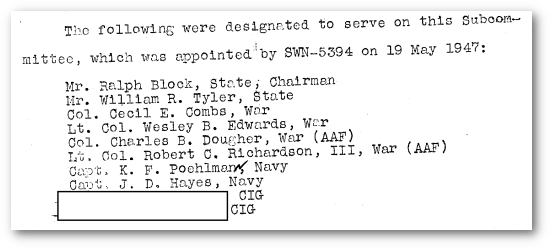
However, Open Source Anomalous was able to locate the same document within Record Group 353 of non-digitized State Department files, where the names remain intact.
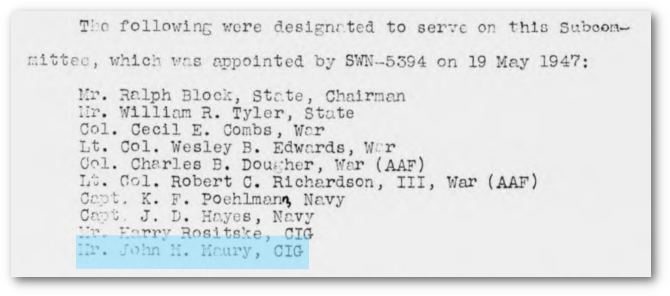
Both individuals listed were involved in Soviet operations within the CIA, but one name stands out: John Maury. According to his publicly available biography, Maury worked under Ludwell Lee Montague at the Office of National Estimates during precisely the timeframe in which this report was produced. Records indicate he was assigned to the SSE from May 1947 through just weeks before the final report would have been presented to Truman.
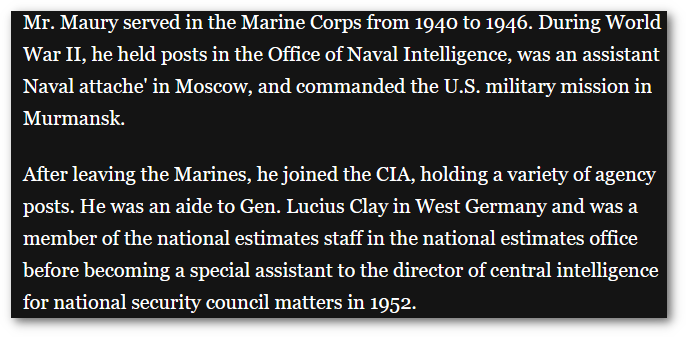
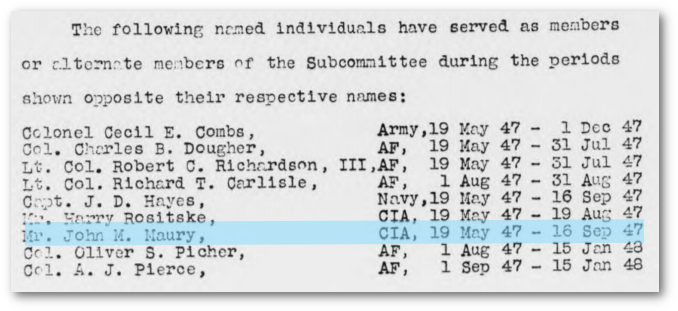
The fact that Maury's role, assignment period, and organizational placement all align with the SSE report's claims adds another layer of independent corroboration.
A Broader Pattern: UFOs, Truman, and Psychological Warfare
This would not be the first time that the Truman administration, UFOs, and psychological warfare were linked in an official capacity.
The Psychological Strategy Board (1952). A Truman era Psychological Strategy Board report from June 1952, the PSB having effectively replaced the SSE's coordinating and policy functions, mentions reports of flying saucers and discusses sending a representative to determine whether civilian photographs of the objects were "authentic." The fact that UFOs appear in PSB records confirms that the psychological warfare dimension of the phenomena persisted through every institutional successor to the SSE.

The CIA’s Office of Scientific Intelligence (1952): A report on the phenomena of “flying saucers” from the CIA’s Office of Scientific Intelligence further reinforces this pattern. Key excerpts include:

The OSI consulted with the Air Force’s Special Study Group and reached specific conclusions about the nature of the sightings.
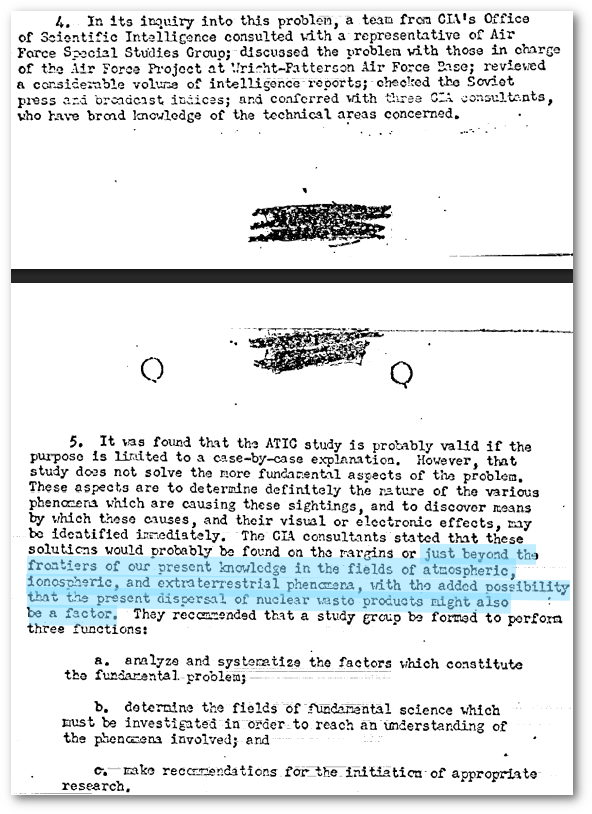
The OSI team concluded that the phenomena represented both an air superiority issue and a psychological warfare issue.
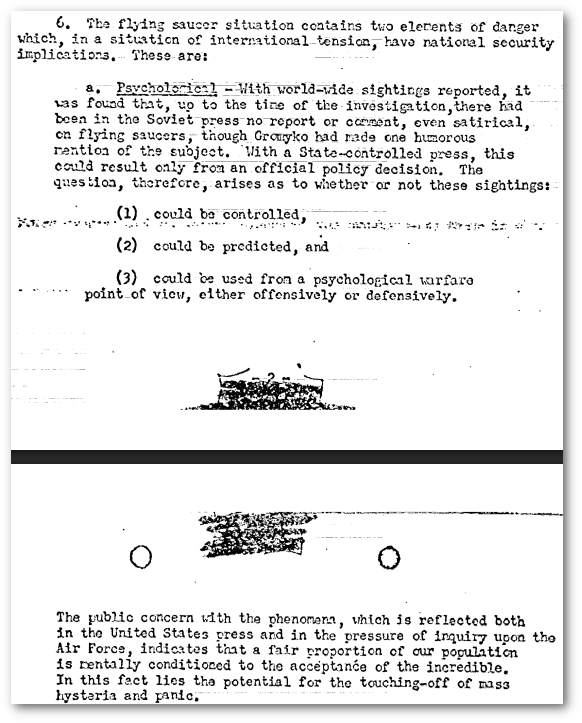
One of the primary operational takeaways was the potential to leverage the phenomena for psychological warfare purposes and public perception.

The report also raised the question of why Soviet broadcasts contained a press blackout on the subject of flying saucers. This strongly implied that U.S. intelligence believed the objects were not Soviet in origin, and that the Soviets may have been adopting the same strategy of downplaying the phenomena to avoid exposing a shared national security vulnerability.
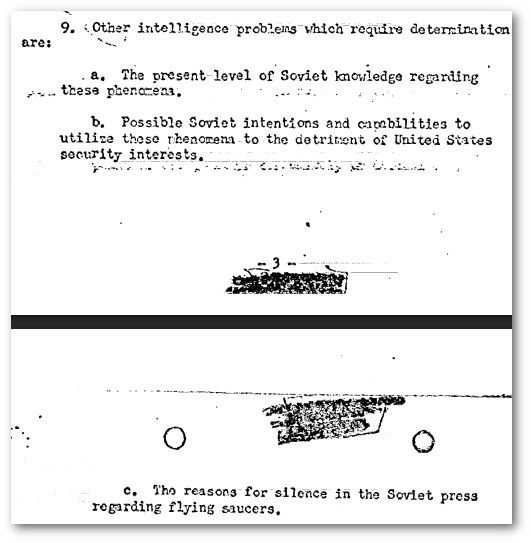
The question this raises is straightforward: if these objects were neither American nor Soviet, whose were they?
The urgency of this problem was such that it was elevated to the National Security Council to establish a community wide coordinated effort toward a solution.

A copy of the assessment, along with a memo specifically for the director of the Psychological Strategy Board, was transmitted. The PSB was the policy coordination body for psychological warfare. It received the assessment. But it could not execute the operational response. That required an agency.

The 1952 Timeline
When you step back and look at the sequence of events, the pace is striking. This is not a slow bureaucratic evolution. This is a crisis response sequence:
June 13, 1952. The Brownell Committee report is completed, recommending the creation of a national level signals intelligence agency. The study had been commissioned by CIA Director Walter Bedell Smith, the same individual overseeing the CIA’s engagement with the UFO problem and the very agency producing the psychological warfare assessments described above.
July 1952. The Washington D.C. UFO flap. Unidentified objects are tracked on radar over the nation’s capital on two consecutive weekends (July 19 through 20 and July 26 through 27). Fighter jets are scrambled. The incidents generate massive national media coverage, prompting the largest Pentagon press conference since World War II. This is not a fringe sighting. These are unknown objects over restricted airspace above the White House and Capitol, confirmed on multiple independent radar systems.
September 1952. The CIA’s Office of Scientific Intelligence, operating under Smith’s authority as Director of Central Intelligence, produces its assessment. It concludes the phenomena are both an air superiority and psychological warfare problem. It notes the Soviet broadcast silence. It escalates to the National Security Council and transmits a copy to the Psychological Strategy Board. The PSB, as a policy board, could coordinate the response. But it could not execute it.
October 24, 1952. Truman signs the memorandum creating the National Security Agency, implementing the Brownell Committee’s recommendations. On that same date, per a note reproduced on the SSE document and attributed to Truman: “I want the Director of NSA to have this for future reference.”
January 1953. The CIA convenes the Robertson Panel, which reviews the UFO evidence and concludes that the primary risk is not the objects themselves but the public reaction to them. The panel’s core recommendation? A coordinated campaign to debunk and downplay UFO sightings, to strip the subject of its “special status” and reduce public interest. That is, by definition, a psychological warfare operation directed at the domestic population.
The Brownell report lands in June. The D.C. crisis erupts in July. The CIA, under the same director who commissioned the Brownell report, assesses the UFO situation as a dual SIGINT and psychological warfare problem in September. The PSB receives the assessment but cannot act on it operationally. The NSA is created in October. The Robertson Panel launches the domestic psychological warfare campaign in January. All under the watch of a single Director of Central Intelligence who had a hand in both the intelligence assessment and the institutional response.
It is worth noting that the SANACC 304/15 document lists among the SSE’s active work items: “Determination of the scope of a Domestic Information Branch of a National Psychological Warfare Agency” and “Determination of possible themes for propaganda based upon estimated national objectives.” The Robertson Panel’s output reads like a direct execution of these exact functions.
Circling Back
So if we can put all of these threads together:
The SSE, the government's sole psychological warfare coordinating body, authored a report on unidentified aircraft dated September 30, 1947, the same date it circulated SWNCC 304/6, its foundational proposal for a national psychological warfare agency. That document was not declassified until 2002, three years after the Majestic SSE report surfaced.
The report is classified under NSCID 6, the foundational signals intelligence authorities that the NSA was created to execute.
The report carries the same NSA Top Secret control number as the 1952 Truman memo creating the NSA. While the memo’s existence was known since the 1980s, its specific markings were not broadly published until months after the SSE report surfaced.
A re-typed note attributed to Truman directs the NSA Director to retain the document, dated the same day the agency was officially created.
The SSE proposed the NSIA, an agency whose organizational structure, NSC oversight, CIA liaison, unified foreign and domestic operations, JCS command channel, and intelligence exploitation mandate are virtually identical to the NSA. The name was explicitly a “cover.” The SSE formally designated itself as the “nucleus” of this future agency.
When the SSE was disbanded in 1949, only its overt psychological warfare functions were transferred to the State Department. The covert functions and any material classified under signals intelligence authorities, including the UFO report, were left without an explicit institutional home. The post-SSE arrangement failed, requiring the creation of the Psychological Strategy Board in 1951 to restore coordination. But the PSB was a policy board, not an operational agency. The operational gap persisted.
The report’s authors can be independently verified through unredacted State Department records, with John Maury’s role and timeline matching the claims.
Multiple Truman era documents confirm the UFO situation was treated as both a defense and psychological warfare problem at the highest levels, with Soviet broadcast monitoring (a SIGINT function under the same authority stamped on the SSE report) as a key intelligence component. The CIA’s assessment was transmitted to the PSB, which could coordinate but not execute.
The official process to create the NSA was initiated by CIA Director Walter Bedell Smith, who simultaneously oversaw the CIA’s UFO assessments and the escalation to the NSC. The Brownell Committee report he commissioned was completed just weeks before the D.C. UFO crisis, and the NSA it recommended was designed to “extend beyond the armed forces,” matching the national level, cross agency scope of the NSIA proposal.
The 1952 timeline, from the Brownell report in June, to the D.C. crisis in July, to the CIA’s dual threat assessment in September, to the NSA’s creation in October, to the Robertson Panel’s psychological warfare recommendations in January 1953, follows a clear crisis response pattern.
The NSA was created as an agency meant to collect, analyze, and exploit communications intelligence. But if it was additionally created, covertly, as the institutional successor to a psychological warfare apparatus that had been managing the UFO situation since 1947, wouldn’t having control of all communications be the best way to do both?
Further FOIA requests targeting NSA founding era records, SANACC archival materials, and Psychological Strategy Board files could help confirm or refute these connections. The primary sources referenced in this article are linked where available. We encourage readers to examine them and reach their own conclusions.
phenomenal research