



In the early 1990s, a small inspection team from the Department of Defense Inspector General (DoD IG) walked into Fort Meade to do something no one had tried before: a full‑spectrum inspection of the National Security Agency. It was the first time the NSA’s internal machinery—its management controls, budgeting, and above all its most sensitive classified programs—had been treated as something that could be audited like any other defense component.
What they found was quietly devastating. In a 1996 inspection report, the IG concluded that the NSA “does not effectively monitor the Special Access Programs it operates or supports.” [1]
This is the bureaucratic terrain on which we have to read Dan Sherman’s account of Project Preserve Destiny (PPD)—an alleged NSA‑managed operation nested inside a U.S. Air Force SAP, dedicated to codifying telepathically received reports of abductions by a non‑human intelligence. Sherman describes an “onion effect” of classification: alien missions at the core, wrapped in black projects that soak up all scrutiny and paperwork.
The IG’s report, the U.S. Air Force’s own SAP doctrine, and the surviving fragments of the NSA’s classification practice together show how that onion could have been engineered in the real system. They do not prove that PPD existed; however, they do give us the wiring diagram for how “above black” programs—ones managed by the NSA, nested under the auspices of official Air Force black projects—could have operated with almost no meaningful oversight.
NSA’s Mission and the Rise of a Hidden Compartment
The National Security Agency was created in 1952, formalizing American signals intelligence—SIGINT—as a permanent, centralized mission. From the beginning, NSA’s job was to capture and exploit emissions and signals that could be turned into foreign intelligence: communications intelligence (COMINT), electronic intelligence (ELINT), telemetry, radar signatures, and, in time, any signal‑like phenomenon that could be measured, encoded, and fed into the analytic machinery of the U.S. intelligence community.
SIGINT’s most sensitive output has long been handled under Sensitive Compartmented Information (SCI) rules. SCI is not itself a classification level; it is an overlay that carves out compartments—codeword circuits—inside which only specially indoctrinated personnel may see or even know of particular sources and methods. Air Force Instruction (AFI) 16‑701 circa 1995 defines SCI as information bearing “special community controls indicating restricted handling within present and future community intelligence collection programs and their end products,” capturing this idea of a second‑layer control system sitting atop standard classification. [2]
Within this world, NSA built its own micro‑architecture of sensitivity. In November 1974, the Director of NSA authorized creation of the Very Restricted Knowledge (VRK) system “to limit access to uniquely sensitive COMINT activities and programs,” administered as a sub‑control system under the SIGINT (SI) banner. VRK was not about classifying finished intelligence product; it was about controlling access to the programs themselves—collection platforms, analytic techniques, special operations. An open‑source analysis of declassified manuals summarizes VRK as an interagency sub‑control system. [3]
By the time the DoD IG arrived in 1991, VRK was a mature, cross‑agency platform housing the most sensitive SIGINT activities the U.S. ran. It sat at the point where NSA’s traditional SIGINT mission blurred into something structurally indistinguishable from a Special Access Program.
What the DoD IG Found
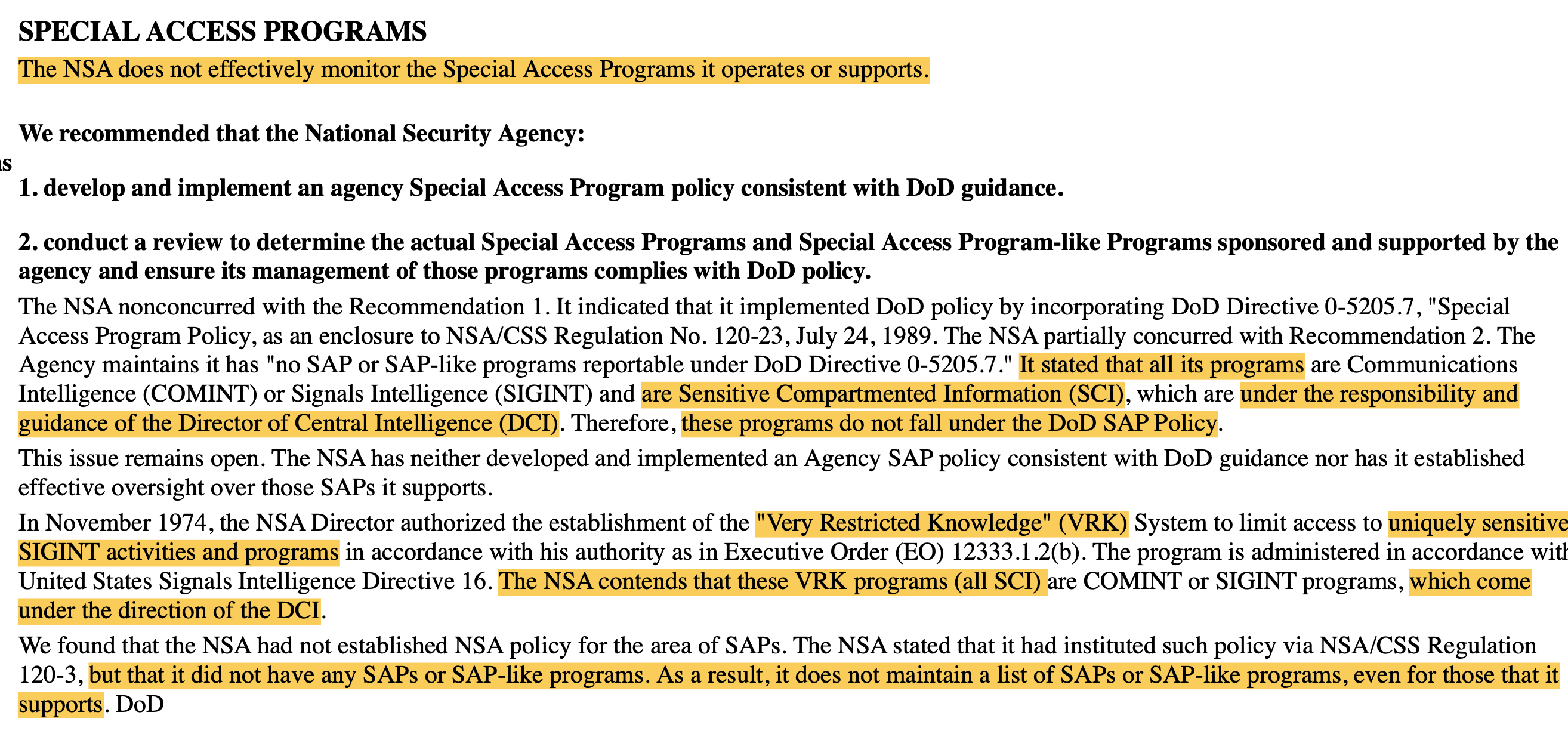
The 1991 DoD IG inspection was intended as a management audit, not a UFO investigation. But its findings on classified programs are directly relevant to any attempt to reconstruct how “grey” operations could hide inside military structures.
The IG summarized its overall conclusion starkly: NSA had corrected only six of sixteen major problem areas from the original inspection. Ten remained inadequately corrected. Among the unresolved issues: manpower planning, internal management controls, SIGINT integration, collection oversight—and Special Access Programs. [1]
On SAPs, the “original issue statement” pulled no punches:
“The NSA does not effectively monitor the Special Access Programs it operates or supports.”
In response to earlier recommendations, NSA claimed it had implemented DoD SAP policy by attaching DoD Directive 5205.7 as an enclosure to an internal regulation. But then it insisted it had “no SAP or SAP‑like programs reportable under Directive 5205.7,” because all of its programs were COMINT or SIGINT SCI activities under the Director of Central Intelligence (DCI).
At the time, the DCI was a dual‑hatted position: the head of the CIA and the overall coordinator of the U.S. intelligence community, responsible for setting policy for national foreign intelligence and for controlled‑access programs within that realm. That role existed until 2004, when the Intelligence Reform and Terrorism Prevention Act created the Director of National Intelligence (DNI) and separated the CIA directorship into its own position. [4]
On this basis, NSA argued that nothing it ran or supported was a DoD SAP. Everything was already fenced off inside SCI compartments directed by the DCI. As far as NSA was concerned, its most sensitive programs fell under intelligence‑community authority, not under the Pentagon’s.
When the IG compared that argument to what NSA was actually doing with VRK, their conclusion was blunt:
“We believe that the definition of SAPs under EO 12958 encompasses the VRK programs currently operating at the NSA.”
In other words: VRK programs were SAPs in substance, whatever NSA chose to call them, and should be subject to formal accounting and annual review by the Pentagon.
Yet at the time of the 1996 DoD final verification report, the IG found that NSA had still not developed a proper SAP policy, had not established an effective SAP coordinator, and had not built a list of supported SAPs that would let anyone see how NSA compartments nested inside other components’ black programs.
The IG’s conclusion on the issue remained unchanged:
“This issue remains open because the NSA still does not effectively monitor the SAP it operates or supports.”
By NSA’s own argument, every VRK program was a DCI‑directed SCI compartment, not a DoD SAP. By the IG’s reading of the law, every VRK program was, functionally, a SAP‑equivalent that should have been tracked and reviewed—but wasn’t. That ambiguity becomes crucial when we look at how the Air Force actually manages its own SAPs.
The Air Force SAP Shell: How Nested Compartments Are Supposed to Work
Air Force Instruction (AFI) 16‑701 is the governing document for how the U.S. Air Force runs its Special Access Programs. It describes SAP security controls—tightened access lists, tailored security guides, special investigative criteria—but it also defines the SAP as the activity being protected, distinct from the security mechanisms around it. [2]
In AFI 16‑701, a SAP is the protected activity or program—the “core secret.” Around that core sit “special access security controls”: limiting personnel to the minimum number necessary, imposing stricter investigative or adjudicative criteria, using nicknames and codewords to label the information, and creating tailored security procedures and oversight infrastructures.
Several provisions of 16‑701 matter directly when we think about a nested NSA program:
Every Air Force SAP, and every SAP the Air Force operates “for other agencies or activities,” must be formally registered with SAF/AAZ, the Air Force SAP Central Office (SAPCO).
The Secretary or Deputy Secretary of Defense must formally approve SAPs in writing and report on them annually to Congress under 10 U.S.C. §119.
SAPs that contain Sensitive Compartmented Information or SIOP‑ESI (Single Integrated Operational Plan – Extremely Sensitive Information) “may have other security control systems, such as SCI,” layered inside them, with SCI directives governing protection of the SCI material.
Programs involving SCI or “intelligence community participation” require review by HQ USAF/IN—the Air Staff’s senior intelligence directorate (historically the Assistant Chief of Staff for Intelligence, now A2).
Taken together, this gives us a layered construct. At the outer level, you have a legally defined SAP—an acquisition effort, an operational activity, or some other black project the Air Force has agreed to protect. SAPCO registers it; DEPSECDEF and the Air Force leadership approve it; Congress receives an annual, highly sanitized summary.
Inside that shell, you can have nested control systems: SIOP‑ESI channels, compartmented operational data, and SCI overlays—such as NSA‑controlled SIGINT compartments—that AFI 16‑701 simply treats as “SCI” for security purposes. Those inner compartments are governed not by the SAP rules, but by intelligence‑community directives: Director of Central Intelligence Directives (DCIDs) at the time, and Intelligence Community Directives (ICDs) today.
The instruction is explicit that inside Sensitive Compartmented Information Facilities (SCIFs), the SAP is just a tenant, while the host SCI sets the rules. In practice, that means the outer program is accountable to Air Force SAPCO, DEPSECDEF, and congressional SAP staff. The inner compartments are accountable to the intelligence agency that owns the SCI system.
The NSA’s VRK structure sounds eerily familiar to the architecture Dan Sherman describes in his book: an Air Force SAP as the outer shell, with a more restrictive NSA‑run compartment nested inside, answerable only to people who have a need‑to‑know. [8]
A Staggering Encounter
It is against that backdrop that Dan Sherman’s account slots into place.
Sherman was a U.S. Air Force ELINT specialist—an “Electronic Intelligence Specialist,” in his own description—responsible for “analyzing electromagnetic energy for intelligence value.” ELINT is a subset of SIGINT that deals with emissions from radars, guidance systems, and other non‑communications electronics. That work routinely falls under NSA’s umbrella, where Sherman recounts spending part of his career on assigned missions.
His story takes a sharp turn when an Air Force captain at the National Cryptologic School reads him into an additional program, Project Preserve Destiny, described as a “genetic management” effort to cultivate “intuitive communicators” for a future crisis in which all electromagnetic communications would fail—where he would communicate with non‑human entities on behalf of the president.
The regimen is conducted at a facility he identifies only as the “PPD school.” To get there, he is collected by a blue Air Force van with heavily tinted windows; he cannot see the route, the driver, or the location. The van delivers him to an underground parking area where he is escorted through a sequence of access control points—first a metal hand‑shaped plate at waist level, then a retina scanner—before being taken into an unmarked elevator with a single button.
The elevator opens onto a windowless space with internal glass walls. On the far side is a small room containing two workstations and wall‑mounted monitors. This is where his intuitive‑communications training begins: tones and sine waves displayed on a screen, exercises in flattening or altering their amplitude by will alone, and controlled drills in “hearing” information that is not presented through any normal sensory channel.
After this course, Sherman is assigned to what he calls PPD Base #1 and later PPD Base #2. At each site, his Preserve Destiny duties are routed through what appears, on the surface, to be an ordinary ELINT terminal on the classified network. The workstation sits in a SCIF‑like environment. To anyone walking past, it is just another console in a signals squadron.
The difference lies in what happens when he opens a particular interface.
With specific keystrokes, he can bring up a hidden reporting window. This is the PPD channel. During scheduled “comms” sessions, he focuses, establishes “remote” contact with the non‑human entity he nicknames “Spock” (and later a second entity, “Bones”), and begins receiving structured data—numbers, phrases, and technical parameters—that he keys directly into the concealed interface.
By the time he reaches PPD Base #2, the data has settled into a highly standardized format. Each session begins with what looks like a preamble: his three‑digit operator ID “118” and a five‑digit code he interprets as a kind of internal routing or “zip code.” That is followed by fields that look less like narrative and more like entries in a technical report.
Holistically, what Sherman describes is a human operator sitting at an NSA‑linked SIGINT terminal, keying structured event records into a concealed compartment. The records are formatted with identifiers, dates, times, geocoordinates, and numeric indicators that lend themselves naturally to database analysis and longitudinal tracking—exactly the sort of schema one would expect from a quietly segregated intelligence feed. However, the context surrounding those data points suggests a far more troubling narrative.
He recalls repeated field labels such as “Potentiality for recall,” “residual pain level,” “nerve response curve,” and “body normalization,” each followed by a two‑digit number. There is an eleven‑digit subject identifier, date and time fields, and latitude/longitude coordinates.
Sherman reconstructs an example of a report as it would have appeared on his screen:
118/23576/Subject10023202036/940107/0430/PotentialityforRecall72/ResidualPain21/NerveResponseCurve63/BodyNormalization97/03835N14503E///
One day, Sherman double‑checks the coordinates, and the latitude and longitude strings correspond to locations within the continental United States. When he recalls the information relayed in the initial PPD briefing, the nature of what he has been recording becomes obvious.
By his own count, he logs more than twenty such abduction reports before he reaches a moral and psychological breaking point and begins looking for a way out of the program.
Inside the Onion
Sherman’s description of how Project Preserve Destiny actually functioned is unusually technical for an alleged alien‑contact narrative. It reads less like a mystical experience and more like someone explaining an additional data feed inside a familiar SIGINT workflow.
In his indoctrination, Sherman is told there is a special classification concept called “Level 1,” a category used to compartmentalize “any and all grey information”—the captain’s term for alien‑related material.
Sherman is then given an explanation of what his handler calls the “onion effect.” The outer layer is unclassified; beneath that lies For Official Use Only, then Secret (Level 4), then Top Secret (Level 3). At Level 2 sit the black missions, and at Level 1 the alien missions—the core of the onion.
The key part of the briefing is how Level 1 hides behind Level 2:
“Black missions, which we call Level 2, are what the alien projects are effectively hidden behind… Wherever an alien project is located there must be a black mission to cover its existence from prying eyes. It creates a highly sophisticated shield designed to mask the grey project’s existence from high level officials who have no need‑to‑know.”
Sherman is told that only a handful of members of Congress and the President are aware of the true alien projects; that “nosy” officials can be briefed into the black mission, “made to feel important,” and sent away satisfied without ever learning about the Level 1 program underneath.
He is also told that when someone is assigned to an alien project, they are also assigned to the covering black mission. If they talk, they can be prosecuted for revealing the black project, allowing the government to “effectively silence and discredit someone without ever having to acknowledge the existence of the alien project.”
Stripped of the alien content, what Sherman is describing is a classification overlay very much like what the IG was seeing in VRK: a small, highly controlled inner compartment hidden behind an ordinary, though highly classified, DoD program.
Mapping the Layers
At this point, the parallels between Sherman’s “onion effect” and the IG’s VRK findings become hard to dismiss as coincidence.
A SIGINT‑centric core.
The DoD IG makes clear that VRK was created specifically for “uniquely sensitive COMINT activities and programs,” and that NSA regarded these as falling under DCI authority rather than DoD SAP rules. Sherman’s day job is ELINT—electromagnetic intelligence, a subset of SIGINT. His PPD terminal sits on that same technical backbone and uses the same sorts of structured, coded reporting conventions one would expect from a specialized SIGINT channel.
In both cases, the core mechanism is the same: a control overlay, an inner ring of access restrictions, that can be dropped inside many different host programs and facilities.
A black‑program shell that absorbs scrutiny.
AFI 16‑701 describes SAPs as the protected activities surrounded by special access controls—small access lists, special investigative criteria, security guides, codewords, and nicknames—intended to isolate “core secrets” from routine information flows. Sherman’s handler tells him, in almost plain English, that wherever there is an alien project, “there must be a black mission to cover its existence,” and that curious officials can be briefed into the black mission, “made to feel important,” and sent away satisfied without ever touching the alien core.
Translate Sherman’s terminology into doctrinal language and the mapping is straightforward. The black “Level 2” missions look like Air Force SAP outer shells. The alien “Level 1” missions look like nested SCI/VRK compartments sitting inside those shells.
Oversight diverted into incompatible channels.
AFI 16‑701 requires that each Air Force SAP, and each SAP the Air Force operates for other agencies, be registered with SAF/AAZ and reported annually, in sanitized form, to DEPSECDEF and Congress. NSA’s VRK list, by contrast, is maintained internally and reviewed annually by the Director of NSA, with reporting expected to flow—if at all—into the DCI’s Controlled Access Program Oversight Committee under DCID 3/29. [9]
The IG explicitly flags this bifurcation when it notes that NSA “has not developed and implemented an Agency SAP policy” and does not maintain a list of the SAPs it supports, even though it supports SAPs for other organizations.
Put more bluntly: the outer SAP is visible to Air Force SAPCO and to those congressional staff cleared into that SAP’s cover story. The inner VRK compartment is visible only to NSA’s internal registry and to the DCI’s controlled‑access apparatus. There is no single oversight body below the very top of the system that sees both halves of the onion at once, with the program’s true purpose spelled out.
Sherman’s account of being assigned both to a black mission and to a grey mission—the alien project hiding beneath a conventional military program—is exactly the kind of layering this architecture is built to support.
FOIA Footprints: Who Owns Project Preserve Destiny?
The open‑source record contains a handful of small but telling signals about where officialdom believes Project Preserve Destiny “belongs.”
A 1998 NSA FOIA log released via Government Attic shows that on January 2, 1998, the Agency logged case 11716 as “UFO – Project Preserve Destiny.” The disposition is listed as “Admin Closure,” with no further detail. This does not prove that records existed, but it does confirm that outside requesters were already asking NSA specifically about PPD in the late 1990s.
More recently, independent researcher Noah Hradek filed a FOIA request with the U.S. Air Force specifically seeking information on Project Preserve Destiny. The Air Force initially responded that it had no responsive records, then sent a follow‑up stating that “the information you are seeking falls under the purview of the NSA” and that his request had been referred to NSA for direct response. [5]
When NSA finally responded, it did so with a classic “neither confirm nor deny” reply—the so‑called Glomar response—citing Executive Order 13526 and asserting that even acknowledging the existence or non‑existence of responsive records would reveal classified information. Hradek published the relevant language from that response: NSA’s position that any further detail about whether PPD records exist is itself exempt from disclosure because the fact of existence or non‑existence remains classified. [6]
That sequence—Air Force disclaims ownership and kicks the request to NSA; NSA refuses even to confirm whether responsive records exist—is exactly what you would expect if PPD were an NSA‑owned compartment nested inside an Air Force SAP.
From the Air Force perspective, AFI 16‑701 compels SAPCO to register the SAP itself and to handle SAP‑related oversight and FOIA triage. But nothing in the instruction requires the Air Force to treat a nested SCI/VRK compartment run by NSA as its own SAP, or to maintain a paper trail under the nickname “Project Preserve Destiny” if that nickname exists only on NSA’s SCI/VRK side.
PPD—if it exists—may be one entry in the internal VRK registry, reviewed by the Director and reported up through controlled‑access program mechanisms under DCID 3/29, not through DoD SAP structures. That is precisely the split the IG was warning about when it said NSA “still does not effectively monitor the SAP it operates or supports.”
Layered classification does not just limit what the public can see under FOIA. Used this way, it actively fractures oversight: DoD SAP reviewers see the outer shell; intelligence‑community controlled‑access reviewers see the inner core; no one below the very top is structurally required to see both views at the same time.
What, If Anything, Changed After the IG Report?
The IG’s recommendations on VRK and SAP oversight were straightforward. NSA was instructed to review all Special Access Programs, SAP‑like programs, and VRK programs it had established or supported; to establish an effective oversight mechanism to ensure “proper coordination, monitoring, and tracking” of those programs; and to ensure that all such activities were reported annually to DoD or to the DCI, as appropriate.
NSA partially concurred. It continued to maintain that it did not have SAPs as defined by the DoD SAP directive, because its programs were SCI under DCI authority, and it pointed out that DoD Directive 5205.7 explicitly excluded SCI programs established by the DCI. The Agency promised instead to develop oversight mechanisms consistent with DCID 3/29 and to work with the DCI’s Controlled Access Program Oversight Committee. It anticipated implementing DCID 3/29 by early 1996.
The IG accepted those comments as “responsive,” essentially deferring to the intelligence‑community‑centric controlled‑access system so long as some form of oversight existed somewhere.
In the years that followed, VRK appears to have been phased out in favor of Exceptionally Controlled Information (ECI), a more general framework for highly sensitive SIGINT compartments. Open‑source analysis of classification manuals and leaked NSA materials notes VRK as a COMINT/SI sub‑control system active from 1974 to roughly 2003, with ECI taking over its function thereafter. [3]
What did not change is the basic structural split the IG identified:
NSA’s most sensitive SIGINT programs are fenced inside SCI‑based control systems—VRK, then ECI—that behave like SAPs but are not reported as DoD SAPs.
NSA continues to support SAPs for other components—the Air Force, NRO, and others—without any outwardly visible NSA SAP registry that links those outer programs to their inner SIGINT cores.
If a program like Project Preserve Destiny exists, there is nowhere in this architecture that requires its true nature to be spelled out simultaneously to the Secretary of Defense, the DCI (or DNI), the Air Force SAPCO, and congressional SAP overseers. Instead, knowledge converges at a handful of gatekeepers: the Director of NSA, a small circle inside the DCI’s controlled‑access program structure, and whatever “Level 1” personnel are actually running the thing.
The Director of NSA as Gatekeeper
One detail in the IG report deserves particular attention. Although NSA claimed not to have SAPs, it did maintain “a list of VRK programs, which are annually reviewed by the Director of NSA.”
Nothing in the IG materials indicates that this annual VRK review was shared above the Director of NSA in a form that would label individual programs in a way visible to DoD SAP oversight or congressional SAP staff. DCID 3/29 placed ultimate responsibility for controlled‑access programs on the DCI, assisted by the Controlled Access Program Oversight Committee, but the mechanics of how individual agency VRK lists were integrated into that process remain opaque in open sources.
In practical terms, this means the Director of NSA sits at a nexus point. VRK programs are visible in operational detail only to the Director and a small cleared staff. Air Force SAPs are visible in operational detail only to SAF/AAZ, relevant Air Staff elements, DEPSECDEF, and a constrained set of congressional overseers. Those two views—the SIGINT inner core and the SAP outer shell—overlap fully only in the minds of a very small number of people at the top.
If Project Preserve Destiny is what Sherman says it is—a long‑term program to cultivate “intuitive communicators” and have them relay structured intelligence about abductions and other non‑human activity—then the VRK/ECI architecture the IG describes is precisely the kind of system that could keep it controlled and unseen.
From the outside, even an experienced staffer would see only an Air Force SAP of unknown purpose with a SIGINT flavor—perhaps an advanced ELINT or “noise‑cancellation” program, the sort of cover Sherman himself speculates about when he notes that his PPD school seems to be co‑located with a black project involving exotic acoustic and electromagnetic technologies.
From the inside, PPD would be an NSA‑owned VRK or ECI entry, one line on a Director’s list of “uniquely sensitive COMINT activities and programs,” existing entirely within the SCI world and never labeled as a SAP.
Those two realities meet only in the hands of someone who can review these nested programs. In practice, that means the Director of NSA—and perhaps the Director of National Intelligence or the Director of the Central Intelligence Agency.
For researchers trying to piece together the truth about non‑human intelligence programs, that is where the IG report leaves us. It does not confirm Project Preserve Destiny. It does something subtler and, in some ways, more important: it shows that the classification and oversight architecture needed to hide such a program is not speculative at all. It is spelled out in black and white in the government’s own oversight history.
The onion, in other words, is real. The question that remains is what, exactly, sits at its core.
Sources:
[1]: https://irp.fas.org/nsa/oig_ir_96-03.htm “Final Report on the Verification Inspection of the National Security Agency”
[2]: https://irp.fas.org/doddir/usaf/16-701.htm “Air Force Instruction 16‑701”
[3]: https://www.electrospaces.net/2013/09/the-us-classification-system.html “Electrospaces.net: The US Classification System”
[4]: https://nsarchive2.gwu.edu/NSAEBB/NSAEBB144/index.htm “From Director of Central Intelligence to Director of National Intelligence”
[5]: https://medium.com/%40noahhradek/dan-sherman-and-project-preserve-destiny-confirmed-8b3b6bf4898d “Dan Sherman and ‘Project Preserve Destiny’ Confirmed”
[6]: https://medium.com/%40noahhradek/an-update-on-project-preserve-destiny-foia-2e4a04ec86e1 “An Update on Project Preserve Destiny FOIA”
[7]: https://www.governmentattic.org/43docs/NSAfoiaLogs_1998.pdf “FOIA Logs for the National Security Agency, 1998”
[8] https://www.aboveblack.com/index.html “Above Black: Project Preserve Destiny”
[9] https://irp.fas.org/offdocs/dcid3-29.html “Controlled Access Program Oversight Committee”
Well written discussion that clearly shows the loopholes in oversight of classified ‘black’ and Legacy Program programs.
Most likely incompetence sits at its core.